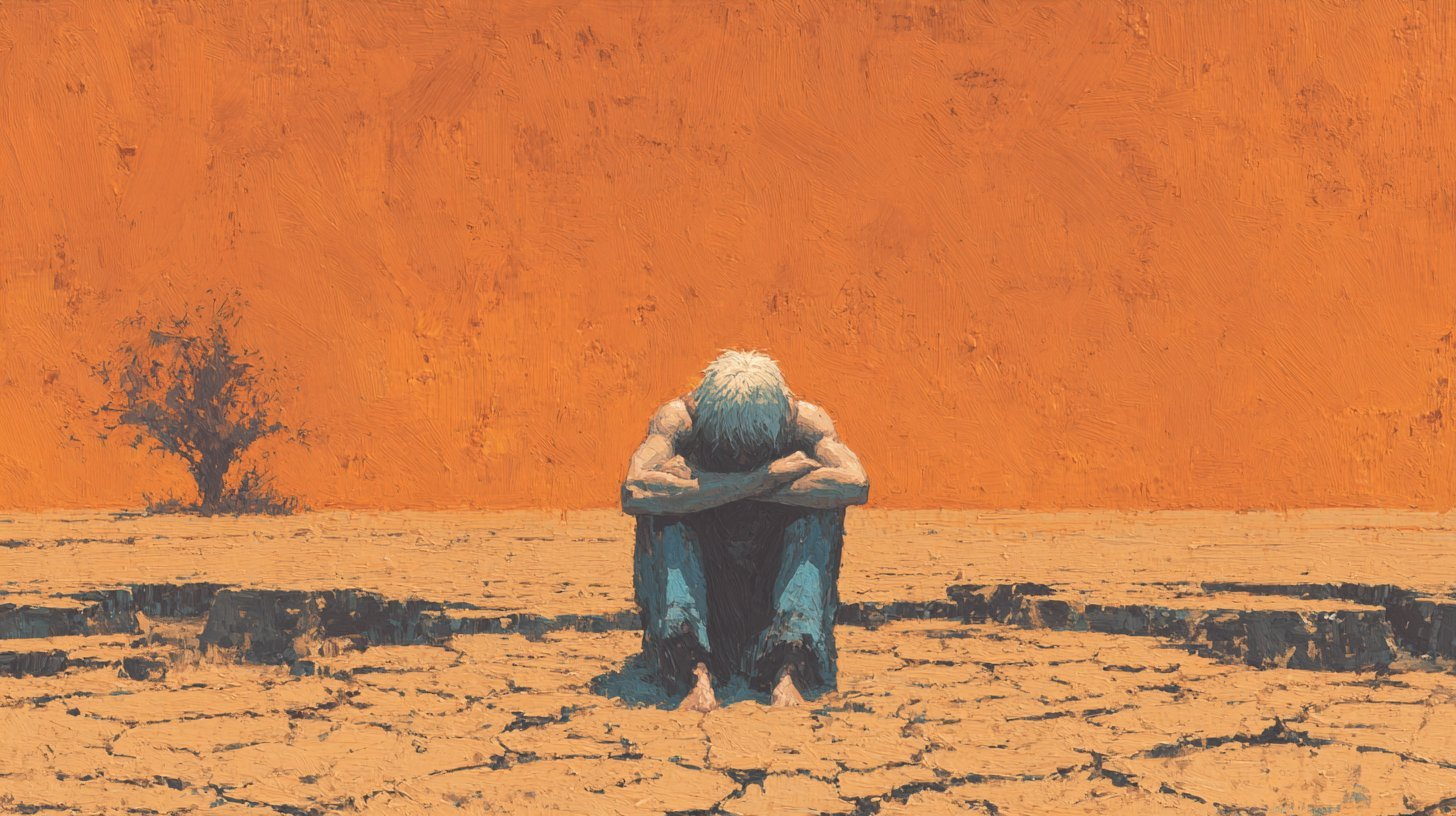
There is a temperature at which a healthy young adult, sitting perfectly still in the shade, fully hydrated, doing nothing more strenuous than breathing, will die. Not from heatstroke in the dramatic sense — not from running a marathon in August or working a construction site in midday sun. From sitting. From the simple, passive act of existing in air that has crossed a threshold the human body cannot negotiate. That threshold has a name. It is called the wet-bulb temperature, and it is measured not by an ordinary thermometer but by one wrapped in a damp cloth — a device that captures the combined effect of heat and humidity on the ability of moisture to evaporate. When the wet— bulb temperature reaches approximately 35°C — equivalent to 95°F at full humidity — sweat can no longer leave the skin. The vapor pressure gradient between the body's surface and the surrounding air collapses to zero. Evaporative cooling, the mechanism that has kept every human being who has ever lived from cooking in their own metabolic heat, ceases to function. What happens next is thermodynamics, not medicine. Core temperature rises. The heart rate climbs as the cardiovascular system attempts to shunt blood to the skin surface. But there is nowhere for the heat to go. Within six hours, internal temperature exceeds the range compatible with cellular function. Organ failure begins. The person dies — not from the heat of the sun, but from the heat of their own body, trapped inside them by an atmosphere that has become a sealed envelope. This was proposed as a theoretical limit in 2010 by climate scientists Steven Sherwood and Matthew Huber. It remained theoretical for a decade. Then, in 2020, a team led by Colin Raymond at Columbia University analyzed weather station data from around the world and found that the threshold had already been briefly touched — along the Persian Gulf coast, in South Asia, and in parts of subtropical Pakistan. The crossings were short, lasting only an hour or two. But they were real. And they were increasing in frequency. The data showed that extreme humid heat events had more than doubled since 1979. Then the theoretical limit itself was revised downward.
The body breaks before the math says it should
In 2022, researchers at Penn State University's HEAT project — Human Environmental Age Thresholds — did something no one had done before. They put the 35°C wet-bulb limit to an actual empirical test, using human subjects performing minimal activity in controlled climate chambers. The results were sobering. No subject in the study reached the theoretical 35°C threshold. Every participant's thermoregulatory system failed at lower temperatures. In humid conditions, the critical wet-bulb temperature averaged 30.6°C — more than four degrees below the theoretical ceiling. In hot-dry conditions, the gap was even wider. A 2023 study published in Nature Communications refined these numbers further by incorporating age and sex differences. For young adults in humid environments, the survivability limit fell to approximately 25.8 to 34.1°C wet-bulb, depending on conditions. For older women — the demographic most vulnerable to heat — the empirical limit was 7 to 13 degrees Celsius lower than the previously published 35°C figure. And in a 2025 study published in bioRxiv, controlled trials across wet-bulb temperatures from 32 to 35°C found that at 35°C, male subjects reached projected heatstroke threshold in roughly seven hours and female subjects in approximately eight and a half — broadly supporting the theoretical timeline but confirming that the margin of safety is far thinner than public discourse has acknowledged. The implication is stark. The wet-bulb threshold is not a distant frontier. It is not a scenario for the year 2100. Research published in PNAS in 2023 projected that uncompensable heat stress exposure — the number of person-hours spent above the empirical danger thresholds — begins to surge at 2°C of global warming, rising from 86 billion person-hours annually to 349 billion at 3°C and over one trillion at 4°C. The regions most affected are the moist tropics and subtropics: South Asia, Southeast Asia, the Persian Gulf, equatorial Africa, and the southern United States. These are not empty deserts. They are among the most densely populated zones on the planet. Many are lower-middle income countries with limited access to air conditioning — the only technological countermeasure that reliably works once the wet-bulb threshold is crossed. At current trajectories, limiting warming to under 2°C would nearly eliminate this risk. Every fraction of a degree above that multiplies it.
The oxygen factory in the warming sea
There is a second, slower mechanism at work — one that operates on a timescale of decades rather than hours, but whose endpoint is no less final. Phytoplankton — the microscopic photosynthetic organisms drifting in the sunlit upper layer of the world's oceans — are estimated to produce between half and two-thirds of the atmospheric oxygen generated on Earth each year. They are not a supplement to the terrestrial oxygen supply. They are the majority of it. Every second breath you take, roughly speaking, exists because of organisms too small to see. These organisms depend on a specific set of conditions: sunlight from above, nutrients rising from below, and water temperatures within their evolved tolerance range. Climate change is disrupting all three simultaneously. As the ocean surface warms, the water column stratifies — warm, buoyant water sits on top of cold, nutrient-rich water below, and the mixing that brings nutrients to the surface slows. A study published in Science Advances in 2025 found that chlorophyll concentrations — a proxy for phytoplankton abundance — are declining across low— and mid-latitude oceans, with reduced bloom frequency documented between 2001 and 2023. The story became more alarming in September 2025, when a team led by researchers at the University of Washington published findings in Nature Microbiology on Prochlorococcus, the single most abundant photosynthetic organism on the planet. Prochlorococcus contributes nearly half of all phytoplankton biomass in tropical and subtropical oceans. The researchers found that it is "surprisingly sensitive" to temperature increases beyond 28°C — a threshold that many tropical ocean regions are expected to exceed by the end of the century. The organism's minimalist genome, which evolved for efficiency in stable, low-nutrient environments, may leave it with limited capacity to adapt to rapid warming. Its thermal comfort zone is narrow, and the climate is moving faster than evolution can follow. Meanwhile, the oceans have already lost 10 to 40 percent of their dissolved oxygen in large swaths, according to a 2024 analysis in Scientific American. Warmer water holds less gas. Reduced phytoplankton production means less oxygen generated. Increased stratification means less oxygen delivered to depth. The ocean is deoxygenating — not catastrophically, not suddenly, but measurably and acceleratingly. A 2015 mathematical model from the University of Leicester calculated that a six-degree Celsius increase in ocean water temperature could disrupt phytoplankton photosynthesis severely enough to threaten the global oxygen supply. Six degrees is at the extreme end of projections. But the trajectory points in that direction, and the organisms we depend on for our atmosphere are, it turns out, more fragile than we assumed. We are not going to suffocate tomorrow. The atmospheric oxygen reservoir is vast — centuries' worth of buffer remain even in catastrophic scenarios. But the system that replenishes it is under mounting pressure, and the pressure is not theoretical. It is measurable, it is accelerating, and it is happening in the water beneath your flight path every time you cross an ocean.
The grief that has no object
There is a third dimension to this story, and it is the one that lives closest to the body. Not the body overheating in humid air, and not the phytoplankton dying in warming water, but the mind processing the knowledge that both of these things are happening — and that the trajectory is difficult to reverse. The American Psychological Association defines eco-anxiety as a chronic fear of environmental doom. A 2024 systematic review published in BMC Psychiatry analyzed 35 studies covering over 45,000 participants and found consistent positive correlations between eco-anxiety and psychological distress, depression, and generalized anxiety symptoms. Recent estimates suggest that 70 to 80 percent of adults experience some level of ecological anxiety. Among young people, the prevalence is higher and the distress more acute — a 2025 analysis of U.S. crisis text conversations found that climate-related texters frequently reported fear, hopelessness, and suicidal ideation, with nearly half expressing a sense that the future held nothing worth living for. This is not neurosis. This is not irrational catastrophizing by fragile minds. The science says the wet-bulb threshold is real, the phytoplankton decline is measurable, and the warming trajectory is accelerating. Eco-anxiety is an accurate emotional response to accurate information. The question it raises is not "why are people anxious?" but "what does a healthy mind do with knowledge that is genuinely threatening, genuinely large-scale, and genuinely beyond individual control?" The research offers a complicated answer. The same 2025 study on ecological anxiety and behavior found that eco-anxiety is positively correlated with pro-environmental action, particularly collective action — people who feel the distress are more likely to organize, protest, and advocate. The anxiety is not paralyzing for everyone. For some, it functions as a mobilizer. But the correlation with depression and helplessness is equally real, and the question of which response dominates depends on something fragile: the belief that action can make a difference.
The air is still here
Let me be precise about what is and is not happening to Earth's atmosphere. You are not going to walk outside one morning and find less oxygen in the air. The concentration of atmospheric oxygen — currently about 20.9 percent — is not declining at a rate detectable in your lifetime. The reservoir is enormous, and even significant disruptions to phytoplankton production would take centuries to meaningfully draw it down. Climate change is not going to suffocate you in the way that the most anxious part of your brain might imagine when it reads the headlines. But climate change is going to make it impossible for your body to cool itself in some of the places where hundreds of millions of people currently live. Not a century from now — within decades, and at the lower end of warming projections. It is going to stress the biological systems that replenish the atmosphere, in ways that are only beginning to be quantified. And it is producing a form of psychological suffering that is new in human experience: the awareness that the physical conditions for human habitation on parts of this planet are narrowing, measurably, while you watch. The wet-bulb temperature is the mechanism most people have never heard of and most policymakers have not yet integrated into their planning. It is not dramatic. It does not produce the visual spectacle of a wildfire or the narrative arc of a hurricane. It produces a still, humid afternoon in which nothing visible happens — and a body that cannot do the one thing it has always done to stay alive. Sweat is ancient technology. It is older than language, older than agriculture, older than the controlled use of fire. It is the cooling system that allowed Homo sapiens to persist-hunt prey across the African savanna in midday heat, the adaptation that gave our ancestors an edge over every other large mammal on the continent. It is, in a sense, the technology that made civilization possible. We are now building an atmosphere in which that technology fails. And the most unsettling thing about the wet-bulb threshold is not that it exists. It is that we crossed it, in some places, before most people learned its name.