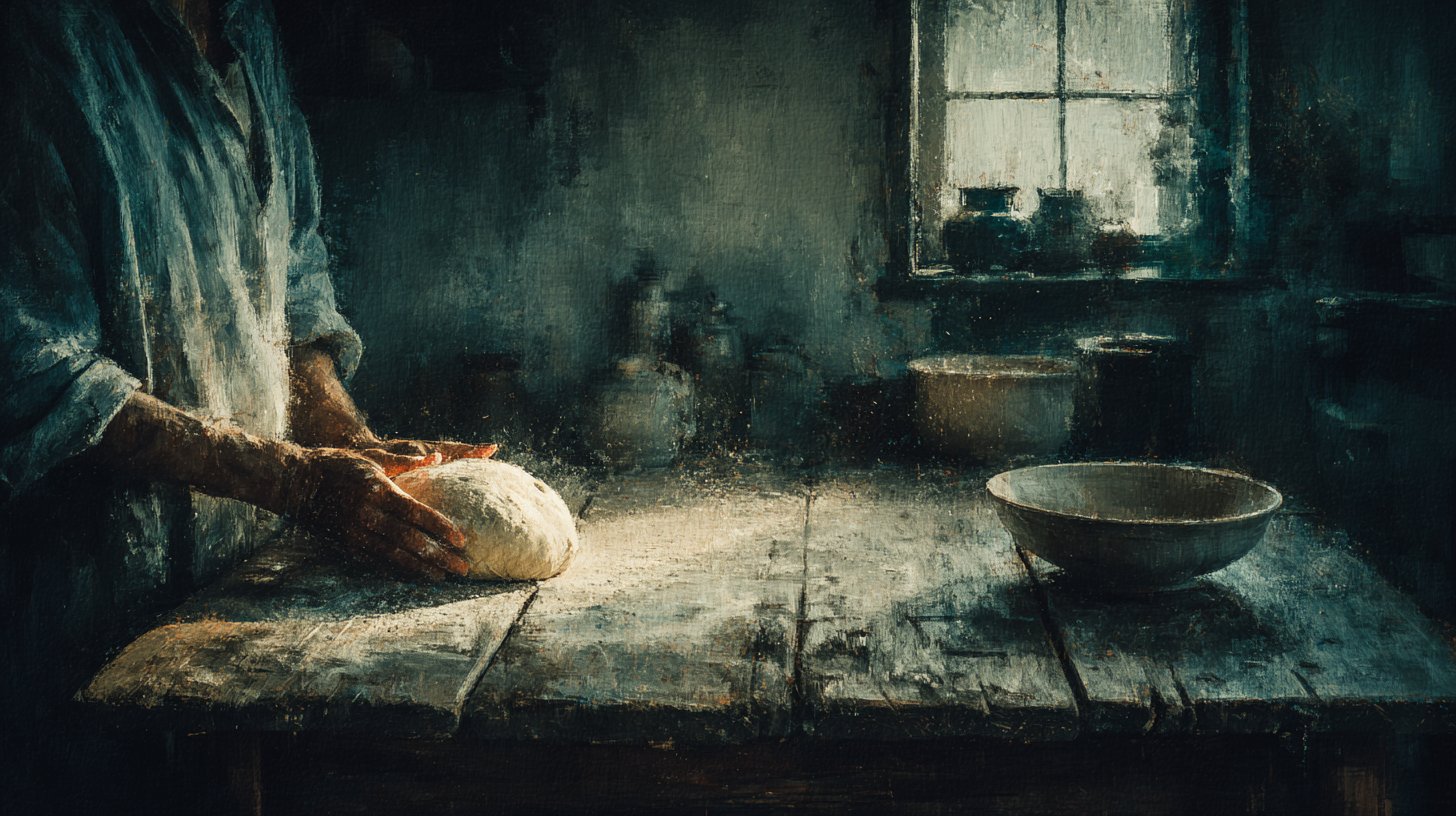
Some things your grandmother knew, she could never write down. Not secrets — things. How to know when the bread had risen. When a neighbor's silence meant grief and when it meant offense. Which cousin you didn't seat next to which cousin. The weather sign her own grandmother had taught her, which she had never once seen fail. None of it was coded. None of it was in books. It lived in her hands, her eyes, the room she moved through. And most of it, now, is gone.
The story most of us tell about this loss blames globalization. The internet flattened everything. Brands colonized the imagination. A generation raised on the same phone watches the same shows and ends up in the same cities wearing the same sneakers. That story is not wrong. But it is very late.
The forgetting started thousands of years earlier. It started the moment someone wrote a custom down.
The code and the custom
In 1861, a British jurist named Henry Sumner Maine published a book called Ancient Law. He was not trying to write cultural criticism. He was trying to understand where law had come from — how humans had gone from the roaring judgments of tribal patriarchs to the dry clauses of Victorian contracts. What he found, buried in the layers of Roman and Irish and Hindu legal history, was a pattern he named in one of the most quoted phrases of nineteenth-century social theory: the movement of progressive societies, he wrote, had so far been a movement from status to contract.
What he meant is simpler than it sounds.
In older societies, your identity came from where you were born. The family you belonged to, the clan, the village — these determined your obligations, your rights, the work you could do, the person you could marry. You didn't negotiate them. You inherited them. They were in the air you breathed, the rituals you performed, the stories you were told. A nineteenth-century reader of Maine, summarizing the point, put it this way: individuals were tightly bound by status to traditional groups, and the modern arrangement would replace those bonds with agreements freely entered into.
Then, slowly at first, something changed. Law began to separate itself from custom. Instead of a judgment spoken by an elder in the moment, you got a clause written in a code. Instead of belonging to a group that defined you, you became an individual who could enter agreements. The contract replaced the kin. The written rule replaced the lived practice.
Maine called this progress. In most ways it was. A person born to a low station could rise. A woman could one day own her own property. A stranger could be trusted on the strength of a signed page rather than a shared grandmother. None of this is an argument for going back.
But something was traded. The moment a custom is written down, it stops being ours and starts being its own thing. It becomes portable. It can be read by anyone, enforced by strangers, carried across borders in a ledger. And anything that can travel can leave.
The smallest law
Consider one tiny example of what writing does.
Starting in the early Middle Ages, the Western Church began issuing a series of marriage rules that looked, at the time, like pure religious bureaucracy. Harvard researchers reconstructing the period have noted that between roughly the fourth century and 1500, the Western Church progressively banned marriages to cousins, step-relatives, in-laws, and even godparents — often extending the prohibitions to increasingly distant degrees of kinship.
It does not sound like a civilizational event. It sounds like canon law.
But the anthropologist Joseph Henrich, with co-authors including Jonathan Schulz, has argued in a 2019 paper in Science that this single body of rules quietly dismantled the kinship networks that had organized European life for thousands of years. Before the Middle Ages, Henrich's team noted, Europe looked much like other agrarian societies: extended kin was the glue that held everything together. After centuries of marriage bans, that glue was gone. People learned to trust strangers, join voluntary associations, and define themselves as individuals rather than as members of a clan.
One written rule. A thousand years of quiet erosion. A continent reshaped.
The shape of everywhere
Now walk through an airport.
Any airport. The one in Istanbul, the one in Frankfurt, the one in São Paulo. They are not identical — but they are versions of each other. Same fonts on the signs. Same coffee chains. Same white-noise hum of the same announcements in the same four languages. Walk out of any of them into the nearest downtown and the pattern continues: the same glass towers, the same boutique hotels furnished in the same moody neutrals, the same restaurants with exposed brick and filament bulbs and a cocktail menu that leans on yuzu.
We know this. We joke about it. The writer Kyle Chayka called it "airspace" — a single aesthetic hovering over every city with a cappuccino machine.
The usual explanation is capital. Big companies, big platforms, big marketing. But that is only the last step. The reason capital can flow this way — the reason a single aesthetic can colonize forty countries in a decade — is that the ground was prepared for it centuries ago. When a culture was still held in hands and rituals, it could not be copied. You couldn't ship it. You couldn't license it. You had to be there. You had to be one of them.
A culture that has been translated into written rules, portable contracts, and standardized institutions is, by definition, a culture that travels. And the thing about travel is that it works both ways. Your local custom can be exported. But someone else's custom can also be imported, and then a third's, until the layers accumulate and flatten into a single low-friction mush that everyone can understand and no one specifically belongs to.
This is why sameness does not feel like invasion. It feels like convenience.
Look at what has happened in a single human lifetime. Regional accents are thinning. Linguists tracking British English have watched distinctive dialects shrink toward a generic "mid-Atlantic" drift that plays well on video. Clothing has done the same — walk through a university campus on any continent and the uniform is roughly identical: denim, white trainers, an oversized hoodie, one specific tote bag. Music taste has flattened into the Spotify global chart. Vocabulary has begun to sync in real time, phrases born in a New York comment thread appearing three weeks later in Seoul classrooms and Istanbul offices.
None of this is a conspiracy. No one is forcing it. It happens because each generation inherits a slightly more portable, slightly more legible, slightly more standard version of the inheritance their parents received — and standardization has a direction. It only runs one way.
Your grandmother's world had texture because it was not optimized for strangers. It assumed you already knew. A dish had a name you couldn't find on any menu. A phrase meant something only if you had heard it from the right person. A song was sung on one particular day and nowhere else. All of this was a kind of friction — and friction is what made a place a place rather than a node.
Modern life has almost entirely erased that friction. Not by force. By design. Airports and apps and operating systems and customer service scripts are all running the same quiet program: make the local legible to the global. Make the inherited negotiable. Make the particular exchangeable.
The question is not whether sameness is good or bad. The question is what we are trading for it, and whether we know we are trading at all.
The forgetting
Return to your grandmother.
There is a version of her still in you, somewhere. A recipe you half-remember. A gesture you make without thinking. A phrase in a language you no longer speak well. These are the sediment of a culture that was never fully written down — which is why it is fading, and why you miss it in a way you cannot quite name.
But here is the stranger thought. A person your age, living on the other side of the world, reading this essay on the same brand of phone, wearing roughly the same clothes, drinking roughly the same coffee, holding roughly the same opinions about roughly the same news — that person is, in a thousand measurable ways, more like you than your grandmother was.
Your grandmother lived in a world that was stranger to her neighbors than your world is to a stranger in another hemisphere. That strangeness was culture. It was what made her from somewhere.
So the question the slow forgetting leaves you with is not whether you have lost something. Of course you have. The question is the harder one: are you more like your grandparents, or are you more like a person you will never meet? And if the answer is the second — which it almost certainly is — what has taken the place of the thing you were supposed to inherit?