In 1802, an English country parson named William Paley published a book that opened with a walk across a heath.
He imagined finding a watch on the ground. A stone he could dismiss — it had always been there, as far as anyone knew. A watch was different. The watch had gears arranged to a purpose. Its parts fit together in ways that required each other. No one, Paley argued, could examine such a thing and believe it had fallen into its form by accident. A watch implied a watchmaker. And the living world — every eye, every wing, every branching of nerve and vessel — was a watch of unimaginable complexity. By his reasoning, the designer had to exist, or the heath would be empty.
The argument was taken seriously for the better part of a century. It was not defeated by theology. It was defeated, slowly and with evidence, by Charles Darwin, and then with fierce clarity by a book published in 1986 by the evolutionary biologist Richard Dawkins. Its title was The Blind Watchmaker. The argument inside it was that Paley had been half right. The watch existed. The watch demanded explanation. But the maker — the maker did not need eyes, or intentions, or foresight. The maker was a process. Variation, plus selection, plus time. Given enough of each, the process would produce watches. It had produced every watch we had ever found alive.
For forty years, this was philosophy. The watchmaker with no eyes was an argument — elegant, widely accepted, evidentially supported by the entire fossil record and every living cell — but not an object. No one had ever pointed at a specific molecule and said: this is the watchmaker, this is what it does, look. The process was inferred from its outputs. The process itself had never been caught.
A paper published in February 2026 by a team at the Medical Research Council Laboratory of Molecular Biology in Cambridge may have done something closer to catching it than any experiment before. The team did not claim to have found the Blind Watchmaker. That is not the kind of sentence biologists write. But the molecule they isolated — a 45-nucleotide strand of RNA called QT45 — does, in conditions resembling those of the Earth some 3.8 billion years ago, exactly what Dawkins said the watchmaker does. It makes more of itself. It makes errors. The errors vary. Some versions copy faster than others. Selection begins.
This is what the rest of this essay is about.
The gradient, the paradox, the molecule that solves both
To understand why QT45 matters, you have to understand three things first: that life and non-life are not a cliff, that the machinery of the living cell is caught in a paradox, and that one kind of molecule can walk through both.
Start with the gradient.
Most of us were taught, by implication if not directly, that there is a clean line between things that are alive and things that are not. A rock is not alive. A dog is. Somewhere in between, the universe is supposed to have drawn a border.
The universe did not draw a border. Consider a virus. It has a body — a protein shell that isolates it from the environment, the first of the two qualities biologists use to define life. It has a payload of genetic material, either DNA or RNA, tucked inside that shell. What it does not have is metabolism — the second quality — which is the ongoing activity by which a cell resists, moment by moment, the slow drift of thermodynamics toward disorder. A virus outside a host is a biological library sealed in a capsule. It cannot eat. It cannot move on its own. It cannot maintain itself. It just drifts. Most biologists today will tell you it is not alive. Most biologists will also tell you it is not dead, and that the fight over which word applies is several decades old and not close to resolved.
What the virus teaches, before any other biology is taught, is that the transition from non-living matter to living matter does not require a leap. It requires a series of small, plausible steps across a gradient — steps taken, over deep time, by things that would have been just as hard to classify as a virus drifting through a droplet today.
Now the paradox.
Inside every living cell, there is a division of labor. DNA stores the information. RNA carries it. Proteins do the work. This sounds tidy, and for most purposes it is. But run it backwards and a problem appears. DNA cannot copy itself. It requires protein enzymes — molecular machines that read its code and build new strands. But protein enzymes are built from instructions encoded in DNA. Which one arrived first? Neither can exist without the other. Every cell you have ever seen presupposes that both already exist and that the loop is already running.
Philosophers call this a chicken-and-egg problem. Biologists call it the central paradox of the origin of life. For most of the twentieth century, nobody knew how the loop could have started. A book of instructions that could not be read without machinery built from the instructions in the book.
And then, in the 1980s, a third molecule began to receive serious attention. It was not a new molecule — RNA had been known since the 1940s — but a new understanding of what RNA could do. RNA, biologists realized, had a hidden property. It was not just a messenger shuttling between DNA and protein. Under certain conditions, certain RNA molecules could fold themselves into shapes that acted as enzymes. They could catalyze reactions. A single RNA molecule could, in principle, carry genetic information and do chemistry on other molecules, including possibly itself. Walter Gilbert coined a phrase for this possibility in 1986, the same year as Dawkins's book: the RNA world. Before DNA. Before protein. A time when the chicken and the egg had been the same animal.
The RNA molecules that could act as enzymes got their own name. Ribonucleic acid plus enzyme, compressed: ribozyme. They exist in cells today — your ribosomes, the machines that build your proteins, are in fact highly evolved ribozymes — but the question the RNA world hypothesis asked was more specific. Could a primitive ribozyme, arising by chance in the prebiotic environment, have copied itself? If yes, the paradox dissolves. If no, life's beginning remains an uncanny leap.
For decades, the answer was almost. Ribozymes had been isolated, engineered, and studied. They could copy short stretches of RNA. But the copying machines themselves were large — typically around 200 nucleotides — and the probability of such a molecule arising spontaneously from a pool of random RNA, without any enzymatic help, was, by most estimates, vanishingly small. The RNA world hypothesis was beautiful. It was also, critics argued, quietly smuggling in its own miracle. A 200-nucleotide ribozyme is not a simple thing. It has to come from somewhere.
What the field needed was a smaller copier. Shorter. Simpler. Plausible enough to have arisen on its own.
What the scientists may have found
In February 2026, Edoardo Gianni, working in Philipp Holliger's group at the MRC Laboratory of Molecular Biology in Cambridge, along with seven other researchers, published a paper in Science reporting the discovery of exactly that.
The method was directed evolution. The team began with a pool of roughly one trillion random RNA sequences, each between 20 and 40 nucleotides long. They placed the pool under a selection pressure: any sequence that could string small three-nucleotide RNA fragments together, using a short template strand as a guide, would be tagged and carried forward to the next round. The ones that failed were discarded. The survivors were mutated, diversified, and subjected to the same test again.
After 11 rounds, three distinct sequences had emerged from the trillion-member pool capable of the target reaction. After further selection and refinement — another 7 rounds, with random mutations introduced to generate additional variation — a single molecule had out-competed everything else. The team called it QT45. Quite Tiny, 45 nucleotides long.
What QT45 does is remarkable enough that the specifics are worth stating carefully. Placed in a slushy, mildly alkaline mixture of salt water and ice — a condition known as eutectic ice, thought to resemble certain environments on the prebiotic Earth — QT45 can use a template RNA strand and a surrounding pool of three-nucleotide fragments to synthesize a new RNA chain, complementary to the template. When the template provided is QT45's own complementary sequence, the molecule makes a copy of itself. It does so at roughly 94 percent fidelity per nucleotide. The yield, over 72 days, is approximately 0.2 percent.
Those numbers are almost absurdly small. Gianni, in interviews, called the rate "unbelievably slow." The molecular biologist David Lilley at the University of Dundee described the result, with characteristic British understatement, as "a good step down the road to proof of principle." QT45 is not modern life. It is not going to replicate in your blender. The reactions that synthesize its complementary strand and the reactions that synthesize itself do not yet occur together in the same tube; the researchers run them separately. Full self-replication — the closed loop in which the molecule makes copies of itself indefinitely in one environment — has still not been achieved.
And yet.
What QT45 demonstrates is something the field had never demonstrated before: a 45-nucleotide molecule, small enough to have plausibly formed by chance on a prebiotic Earth, can perform the two most difficult reactions a primitive copier would need to perform. It can synthesize its own complementary strand, reading one RNA template and producing another. And it can read that complementary strand back, synthesizing a copy of itself.
Two reactions. One molecule. Both of them, in eutectic ice.
Here is where the essay has to become careful.
There is a powerful and accurate temptation to call the 6 percent infidelity of QT45 a weakness of the experiment. It would be, if the molecule were an industrial enzyme being evaluated for fidelity. But in the context of origin-of-life research, the temptation is exactly backwards. A copying process that reproduced its input perfectly would produce identical copies forever. No variation. No difference between parent and daughter. No substrate on which selection could act. Evolution requires error. Without mutation there is no diversity; without diversity there is no competition; without competition there is no selection. The 6 percent infidelity is not the flaw of the experiment. It is the evolution, already visible in the jar.
The team confirmed this directly. When QT45 was allowed to copy itself over multiple rounds, the population diversified. Some of the daughter molecules were less efficient than their parents and fell behind. A few were more efficient — they assembled the surrounding three-nucleotide fragments faster, they held their templates more reliably, they persisted longer. Those daughters made more daughters. The population began to drift, with direction, toward molecules better at the task than QT45 itself.
This is not a model of evolution. This is evolution, in a tube, over 72 days, unfolding under observation.
The origin of the origin
Now the harder question.
The origin of life has been, for most of scientific history, the framing every researcher in the field has worked inside. How did organization begin? How did a chemistry stable enough to persist, flexible enough to vary, and consequential enough to matter emerge from an environment of nonliving molecules? These are real questions, and they remain real. But the QT45 result reframes them, if you look at it with the Dawkins argument in mind.
The reframing is this. The origin of life is a historical question: when did it happen, where, under what conditions? The origin of the organization — the origin of the process by which organization arises at all — is a different question, and the answer to it is not a historical date. It is a description of a mechanism. Variation. Selection. Persistence. Time.
The origin of organization does not have an origin in the historical sense. It has a signature. Wherever chemistry is given enough raw material, enough energy to keep reactions running, and enough time to accumulate changes, organization emerges. Not as a miracle, but as a statistical inevitability. The Blind Watchmaker is not something that happened once. It is what always happens, whenever the conditions are available.
Gianni and his co-authors, in the discussion section of their paper, make a claim that reads quietly in academic prose but carries considerable weight: the discovery of polymerase activity in a small RNA motif suggests that polymerase ribozymes are more abundant in RNA sequence space than previously thought. Translated out of the hedged language of a Science paper, this says: the kind of molecule we found is not rare. The search space we explored was one trillion sequences. The total possible space of 45-nucleotide RNA molecules is something like 1027. There are almost certainly many more QT45s out there than the single one we happened to find. Self-replicating RNA, in other words, may be an ordinary outcome of the right conditions, not an extraordinary one.
The implication, if the implication holds, is the quiet but seismic move the essay has been building toward. It means that the origin of life — not a specific event, but the kind of event — may not be the improbable miracle the twentieth century often framed it as. It may be the ordinary and expected result of chemistry running for long enough in the right slush. The rare part was never the process. The rare part may have been only the observation.
And if that is true, then Paley's heath is not quite the scene he imagined. He did not pick up a watch that required a watchmaker. He picked up a watch that had been made, over vast time, by the process of being a watch. The gears arranged themselves because the arrangements that worked persisted, and the arrangements that did not did not. The process is what Dawkins named. What the scientists in Cambridge appear to have done, in a frozen salty puddle in a laboratory in 2026, is show us the process at work on a molecule small enough, in conditions plausible enough, to count as the first direct observation of it.
Nobody in the field will say this in these words. That is not how scientific language is written, and the appropriate caution is considerable — the experiment has limits, the system is still artificial, the reactions are still run in separate tubes, the yield is still vanishingly low. All of those caveats are real and important. QT45 is not the last word on the origin of life. It is, at most, the first word that has ever been spoken by an actual molecule.
Closing
Consider the molecule as it sits in the ice.
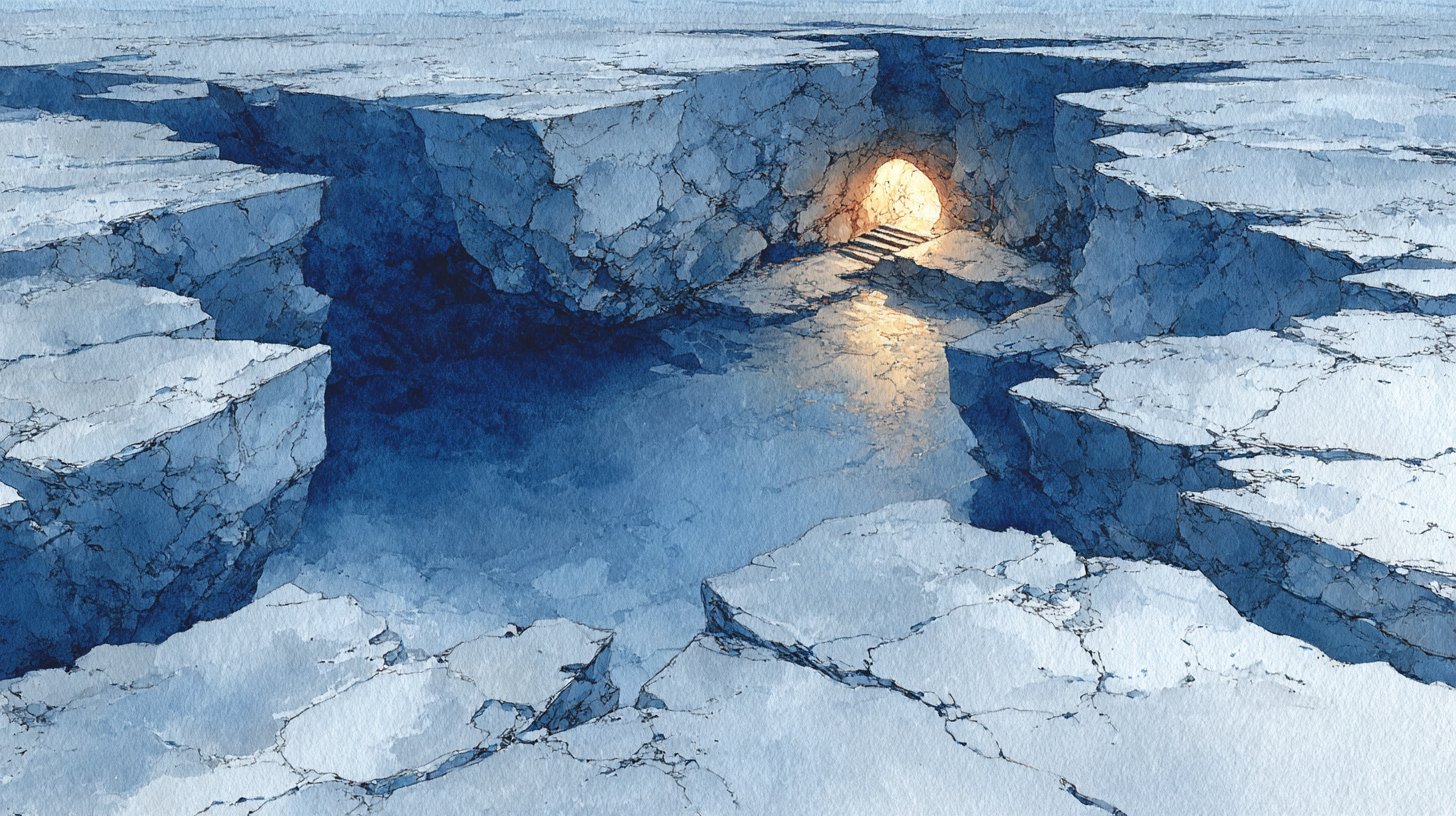
Forty-five nucleotides long. Roughly one ten-thousandth the mass of a single bacterial protein. Suspended in a pocket of unfrozen salt water trapped between ice crystals, in a laboratory in Cambridge, at minus seven degrees Celsius. Around it, floating freely, are trinucleotide fragments — the three-letter building blocks it uses as substrate. Against all thermodynamic instinct, over a period of weeks, the molecule assembles those fragments into a copy of itself. Most of the copies fail. A few succeed. Of those few, some copy faster than the original. Those go on to produce more.
Three-point-eight billion years ago, if something like this was happening in the actual ice of the actual Earth, nobody was watching. The process did its work without an audience, without a name, without a theory. It produced, eventually, the cellular lineages that became the archaea and the bacteria, which became the eukaryotes, which became the multicellular organisms, which became the vertebrates, which became the hominids, which became the physicist who worked out the thermodynamics of the ice, and the chemist who synthesized the trinucleotide substrates, and the biologists in Cambridge who placed the trillion-member RNA pool into the eutectic slush and waited to see what it would do.
The Blind Watchmaker is not a metaphor that describes what happened. It is, if the Cambridge team is right, a name for a process that has now been observed directly. In a tube. With a pipette. At a measurable rate. The argument philosophers have debated for forty years and theologians for two hundred may have, very quietly, in February 2026, become a laboratory finding.
The most astonishing sentence in the history of biology may still be the one no one has yet had the nerve to write: The origin of life is not a mystery. It is a mechanism. We have now seen the mechanism at work.
We are, all of us, descended from something very much like QT45. The beings who read this essay — complex, literate, self-aware, built of trillions of cells coordinating through billions of synaptic connections — trace our deepest ancestry to a stubborn fragment of RNA in a frozen puddle, refusing, against enormous thermodynamic odds, to stop making more of itself.
It is a poetic fact. It may also, from now on, be a scientific one.